Tuesday, February 21, 2006

Cracked Jack Davis


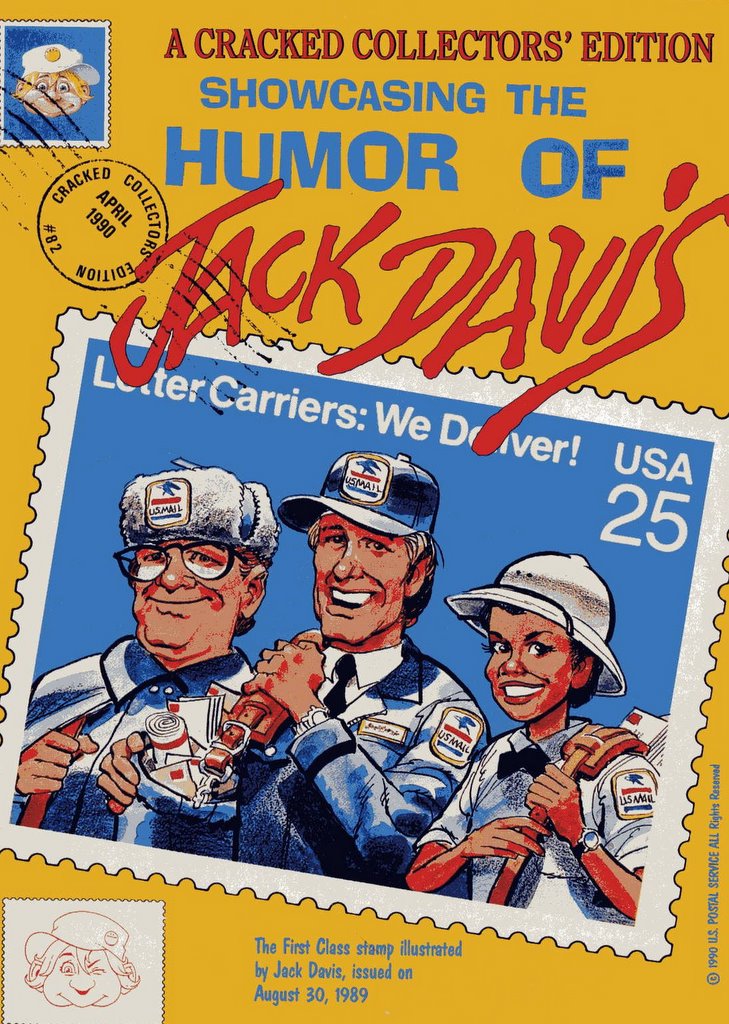
Jack Davis is probably the comic book artist with the most instantly recognizable style to the general public. This is, of course, due to his decades of advertising work for television, magazines and, as seen here, even a postage stamp! Still, it's hard not to think of Jack as a comics artist when you consider how important his work was to defining the style of EC Comics and MAD. Thus I was surprised to find this forgotten magazine in my archives the other day showcasing Davis' work for longtime MAD rival CRACKED! Published in 1990, three years after THE ART OF JACK DAVIS, also seen here, this is a very nice collection. Along with a huge amount of reprints, there is also a nice career overview by EC uber-fan (and later Wally Wood biographer) Bhob Stewart as well as a knowledgable introductory piece (printed in mid-mag for some reason) by CRACKED editor-in-chief Michael Del-Femine. Both of these text pieces are surprisingly illustrated with bits of the artist's NON-CRACKED work! The art is wondrous and hilarious as to be expected and the whole tribute suffers only from the fact that CRACKED's writers were never as funny as MAD's. THE ART OF JACK DAVIS is one of those gushy salutes that are great if you already love the artist but offer little real insight. An obsessively detailed checklist is the meat of the book along with lots and lots of rare Davis illustrations. Not all of them are reproduced all that well but all are still choice. The nifty back cover reproduced here is a collage used in 1979 to promote the artist's signing with a new ad agency. Feel free to check way back in our first week for a look at Jack Davis and Nick Meglin's SUPERFAN strip!

Monday, February 20, 2006

Pink Panther Ads


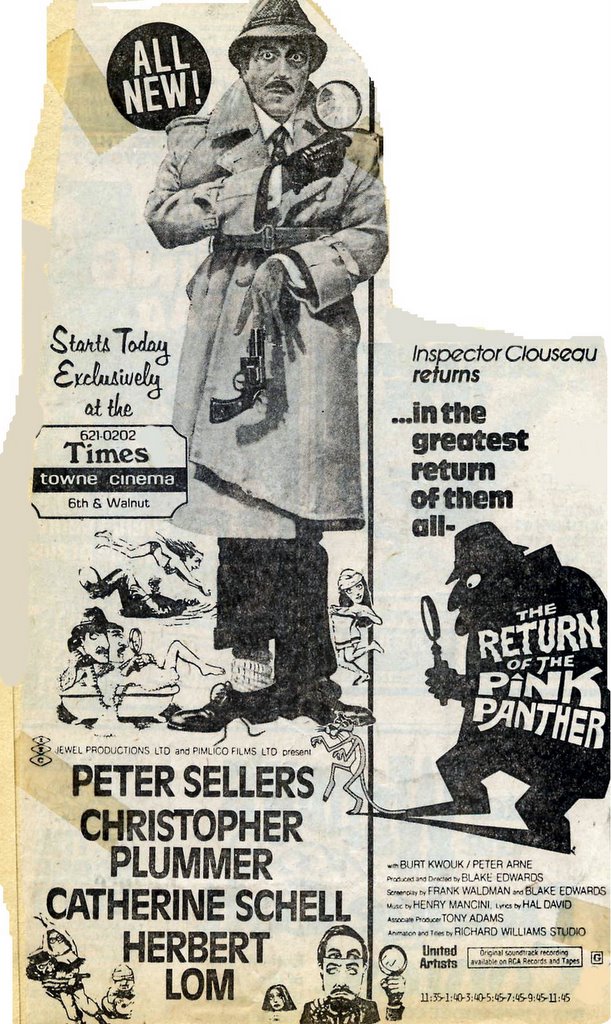
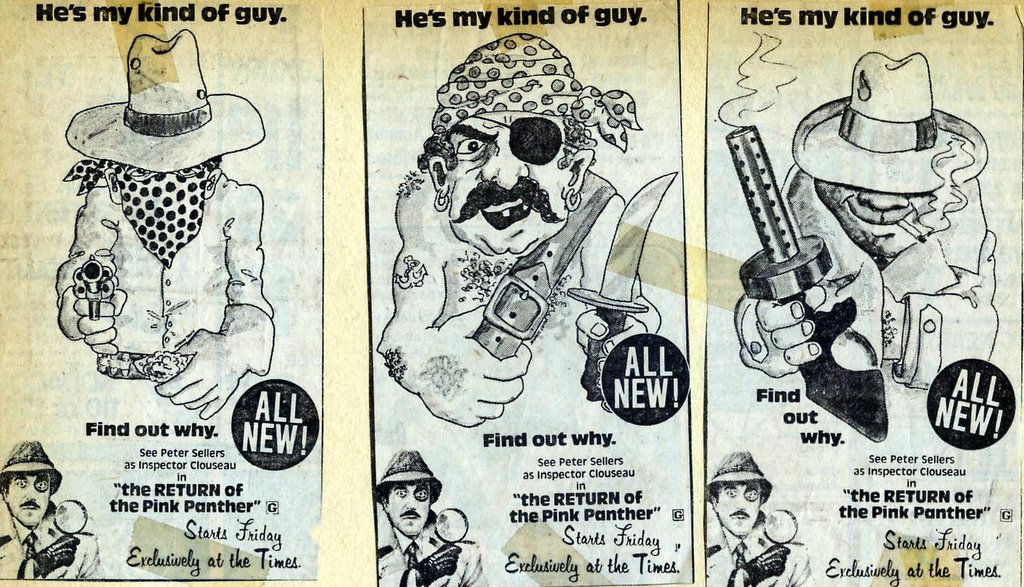
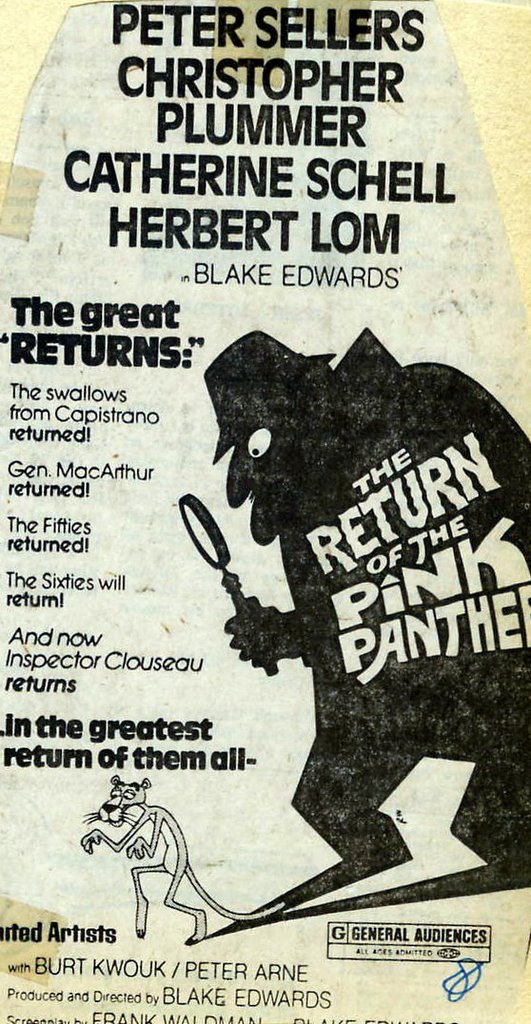
The main criticism of the new PINK PANTHER movie seems to be that Peter Sellers is dead. That, of course, says much more about the late Mr. Sellers than it does the movie. The filmmakers argue that Inspector Clouseau is a classic character, like James Bond and Sherlock Holmes, that can be successfully reinterpreted over and over again by various actors. This has yet to be proven the case. Versatile actor Alan Arkin took on the role in the forgotten 1968 film, INSPECTOR CLOUSEAU. Coming soon after the original 1964 PINK PANTHER and its semi-sequel, A SHOT IN THE DARK, it must have seemed as good a time as any to replace the mercurial, volatile British comic genius but it was roundly ignored and rarely even revived today on cable! Then, finally, in 1975 producer Blake Edwards returned to Peter Sellers at a low point in his professional life and succeeded in reviving both of their careers with THE RETURN OF THE PINK PANTHER. A self-proclaimed man with no personality of his own, the actor effortlessly slipped on the persona of the bumbling French detective again and suddenly became box office gold. This picture, featuring Christopher Plummer reprising David Niven’s starring role in THE PINK PANTHER and a pre-SPACE 1999 Catherine Schell, was a tad more serious than the series’ later entries but you can’t tell it from Sellers masterful silliness. Still, part of the success of the film surely must be attributed to the marketing which presented multiple variations on newspaper ads for days prior to the opening. Seen here are just a few (along with the CINCINNATI POST's contemporary review). This type of campaign was revisited with each of the subsequent Panther films, going so far as to even have exclusive regional ads. We’ll run more from the Library’s collection later.

Sunday, February 19, 2006

Metamorpho, the Element Man


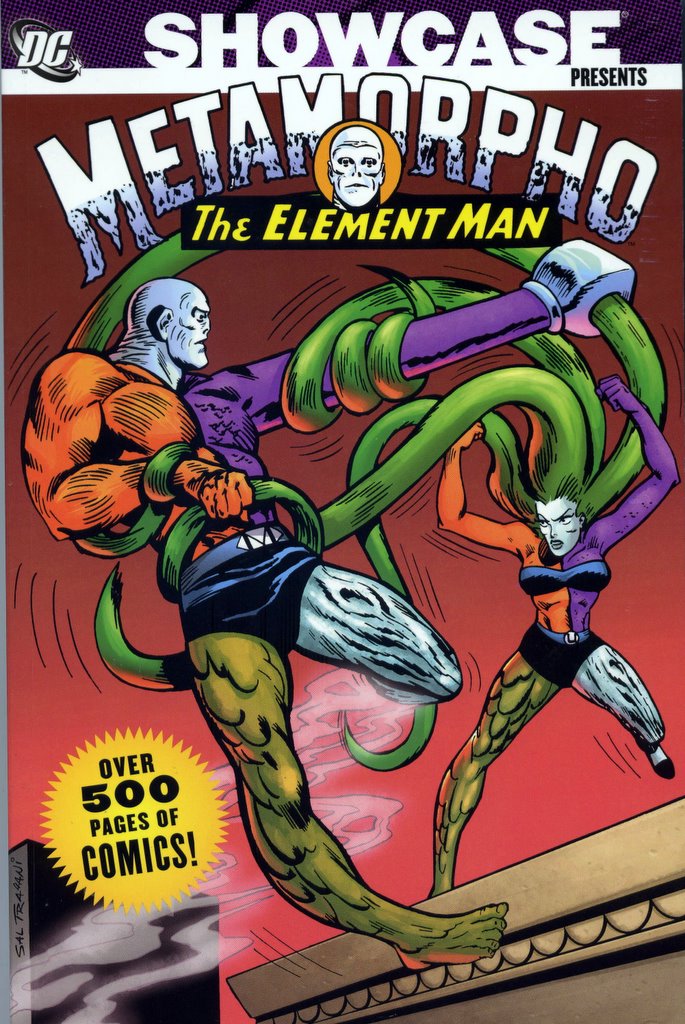
METAMORPHO ran for a total of 22 issues in the mid-sixties and that’s if you count his two BRAVE AND THE BOLD tryouts, his two B&B team-ups and his one JUSTICE LEAGUE OF AMERICA guest shot, all of which are reprinted in one of DC’s recent SHOWCASE PRESENTS volumes. Apparently he was quite popular at one point though as there was also the children’s record seen here (and later re-released in the seventies on an album with other DC super hero records) as well as an intended (but as far as I know never done) cartoon series as advertised in DC comics of the day.
As far as the series itself, there was a certain amount of sixties camp, particularly in the dialogue and the humorous introductory panels of each issue. Bob Haney, a writer who never let continuity get in the way of telling a good story, created the character and wrote nearly all of his original appearances. Personally, Rex Mason, the soldier of fortune who becomes the Element Man, always reminded me of Ben Grimm. His girlfriend was flighty socialite Sapphire Stagg whose overbearing, power-hungry millionaire scientist father (think Claude Rains mixed with Edward Arnold) funded Mason’s expeditions. The other regular was Java, a Neanderthal man Rex had found frozen in ice on an expedition before the series even started (nice touch. The characters had a life before we met them). Simon Stagg had revived him and trained him as an all-purpose servant. Stagg was a fascinating character as he wasn’t technically a villain but his power madness caused him to act that way frequently, particularly when it came to utilizing Metamorpho for his own ends. At the same time, he tried to please Java who was jealous of Sapphire’s love of Mason in spite of the deformities his powers caused him.
Ramona Fradon, one of the few women comics artists of her day and the long-running artist of DC’s AQUAMAN defined the characters with her early pencilling while long-time BATMAN inker Charles Paris joined on inks for most of the series. As a youngster I of course, missed the connection but now I see a very definite Milton Caniff influence in her style which is here given a unique turn with Paris’s well-honed Chester Gould look. In fact, I was surprised to see that Fradon left the series after issue 4 because her replacements, EC’s Joe Orlando and Sal (who REALLY drew this?) Trapani continued her style almost slavishly at least as far as the characters went. Since artists were rarely credited on the book, I just presumed until yesterday that Fradon had drawn most of the issues! Only the final issue with its unattractive, ultra-sketchy art by Jack Sparling (for whose work I have developed some respect over the years but still don’t care for his comics art) looked at all different.
The stories are all entertaining but many of the early ones are repetitive. Later on they even introduced, as was apparently required in the sixties, a female version in the form of Element Girl (who would recieve her own surprising revival in Neil gaiman's SANDMAN of all places!) Assuming Haney knew what he was talking about, the various elemental references actually make the series educational. Another aspect that I had totally forgotten was Metamorpho’s costume that appeared briefly in his second and third appearances (See inset).
In the end, though, the series was perhaps too unique for its times (and company). After his cancellation, METAMORPHO remained off-scene for several years before turning up in a series of totally forgettable back-up fillers in ACTION COMICS. Later on, he finally said "Yes" to the Justice League and like most nostalgically viable characters, underwent several other pointless revivals. I congratulate DC on choosing Element Man for this early reprinting. This bodes well for seeing volumes of METAL MEN, SUGAR AND SPIKE and INFERIOR FIVE on the shelves at Borders before we know it! Thanks, DC!

The Harvey Spirit


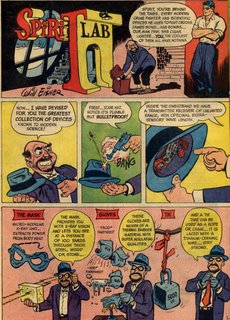
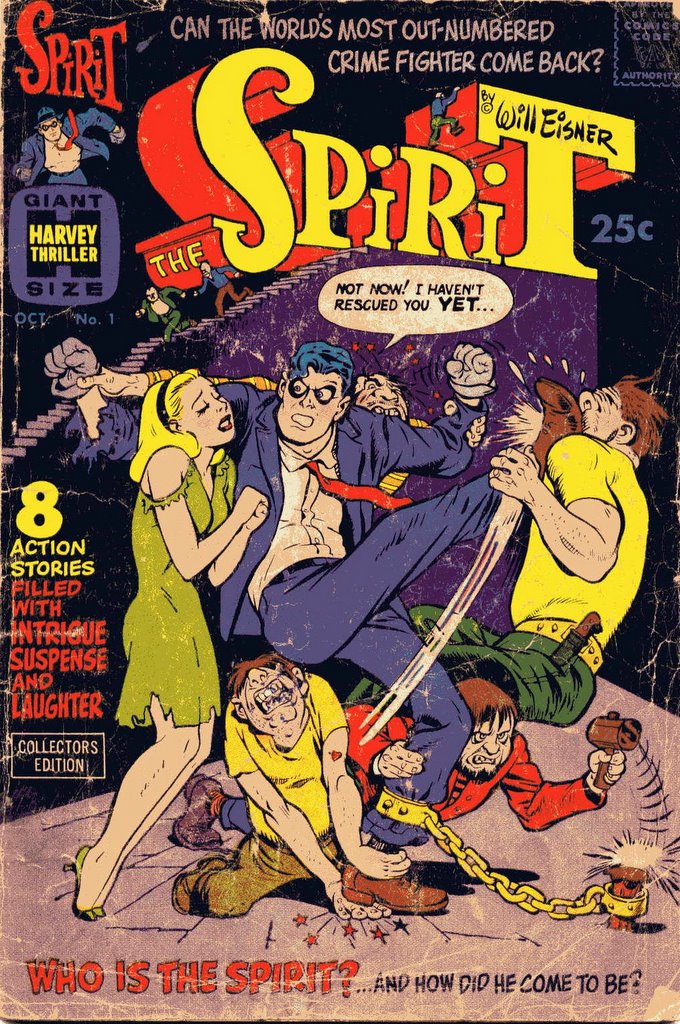
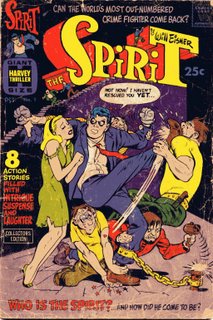
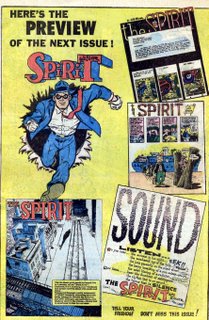
I find myself wondering if DC, in its laudable attempt at re-publishing Will Eisner’s SPIRIT stories, will eventually reprint the hundreds of pin-ups, posters, covers and even the few new stories that the Master created with the character or just leave it at the canonical newspaper appearances. In spite of Eisner’s long-time insistence on not doing new SPIRIT stories, it’s amazing how much new material there was! This being Sunday, when one might naturally expect a SPIRIT section in the good old days, I thought I’d revisit the first time I personally ever met the former Mister Denny Colt. That would, of course, be in the two 1966 Harvey Comics issues. I’m on record as saying I didn’t know what to make of them when I first ran across them at my friend Greg’s house. I remember us sitting at his kitchen table trying to somehow reconcile these strange new stories with Spidey and Batman. They were funny, yet serious. The hero had no super powers and barely appeared in some of his own stories. They were also printed a little smaller than regular comics art. In other words they were…different! I couldn’t get them out of my mind, though and eventually had to trade Greg some old coverless JOURNEY INTO MYSTERY Thor issues for them.
One can trace the timeline fairly directly in retrospect. Harvey Kurtzman (What would our pop culture have done without him!) had reprinted a SPIRIT story in his HELP magazine a couple years earlier. In January of 1966, Eisner created a new, albeit thoroughly apocryphal, story for the legendary NEW YORK HERALD TRIBUNE special comics related supplement (which also featured a controversial Stan Lee interview that’s widely believed to have ticked off both Ditko and Kirby!).That same month, TV’s BATMAN appeared, immediately revitalizing the comic book industry. Harvey comics, purveyors of CASPER, LITTLE DOT and RICHIE RICH wanted some of the resulting moola and jumped squarely into the super-hero market with a line packaged mostly by Jack Kirby’s longtime partner Joe Simon. I’m not certain who called whom but the idea for the return of the SPIRIT must have been set in motion fairly quickly considering the lead-time necessary to put out a comic. Still, since Eisner owned (and retained) his own copyright as well as most of his original art and only a few new pages were commissioned along with the great covers, it would certainly be possible to get it colored and ready by mid-summer. Although dated October, comics in those days routinely came out about three months earlier than their cover date (the theory being that news vendors were so dumb they’d never catch on, thus leaving the mag on sale longer than it should be to increase the likelihood of extra sales. More often than not, the old issue was simply pulled when the new one arrived so this concept only really worked with one-shots) so the first issue of Harvey’s SPIRIT probably was on the stands by July. This is, in fact, borne out by the Dec 15 date stamp on the cover of my copy of the second issue. Dealers often stamped the received date on the top mag in a bundle. Thus, although dated March of 1967, THE SPIRIT # 2 was out before Christmas in 1966.
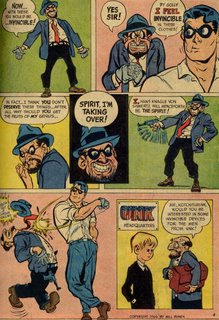
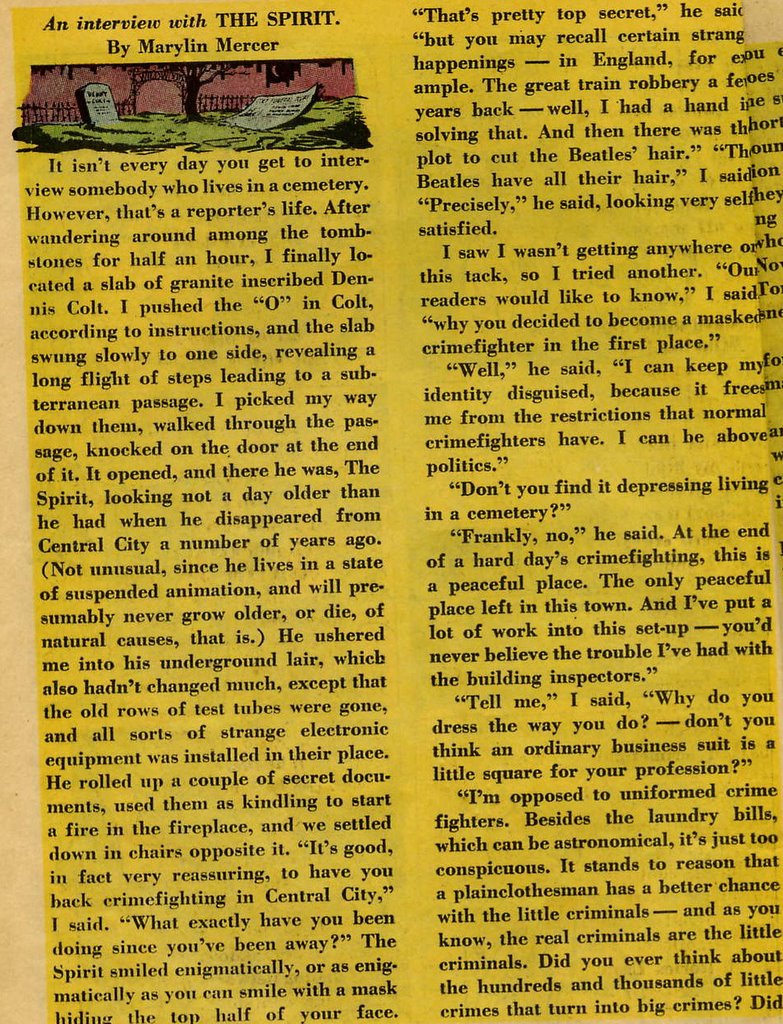
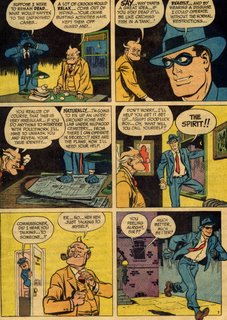
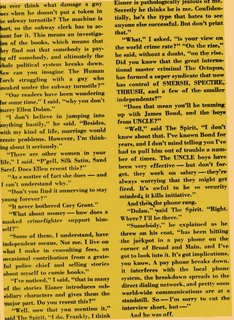
Anyway, the new stuff in these two issues is slight by comparison to the truly classic stories reprinted. With the aid of assistant Chuck Kramer, Eisner offers a whole new look at the character’s origin and a couple of comedy shorts. Perhaps most interesting is a two page INTERVIEW WITH THE SPIRIT text piece that clearly ties the character into the moment with references to 007 and U.N.C.L.E. This piece is credited to Marilyn Mercer who, at one time, had been Will Eisner’s office manager and, more recently in her role as a journalist, had been one of the folks involved with the NEW YORK HERALD TRIBUNE revival of the Spirit!
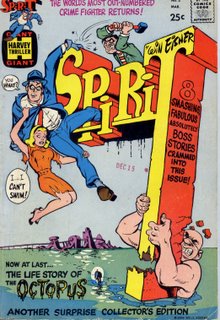
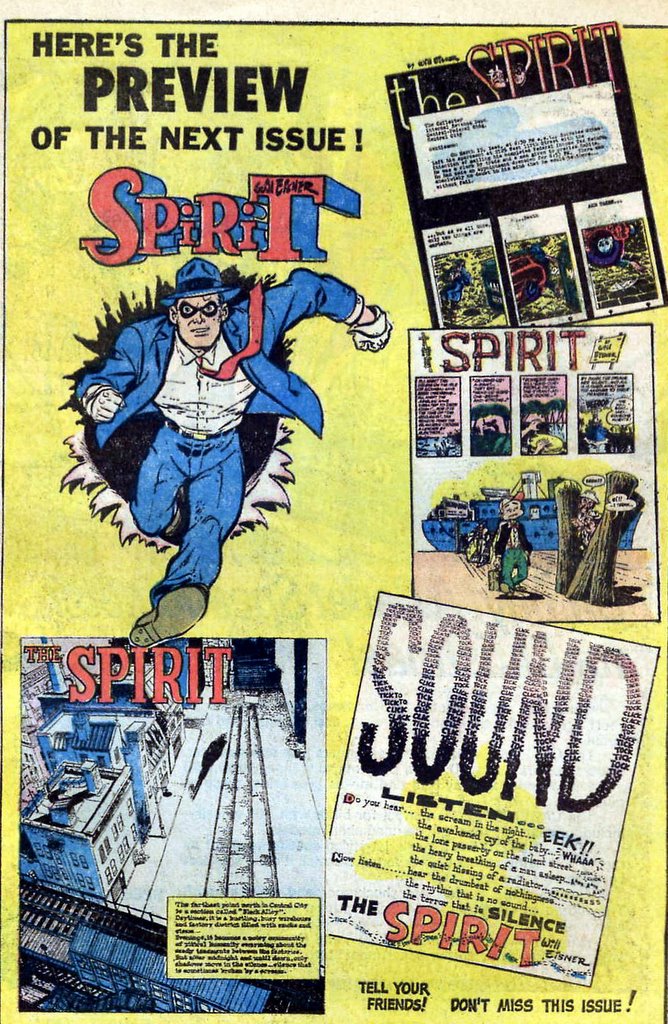
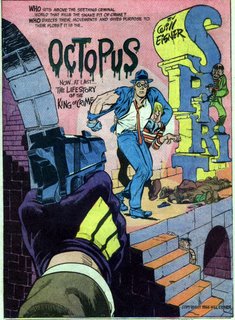
Issue two presents an all-new origin for the Spirit’s gloved but otherwise unseen foe, the Octopus. There’s another throwaway humor piece also as well as a letters page offering spurious letters seemingly designed to answer anticipated questions regarding the character such as why he had no powers, was it true he had been published before, etc. In reality, there probably wasn’t time for any real letters to have arrived and be printed by the second issue in spite of the quarterly publication schedule. This, of course, means there sales figures were not in either so why was it cancelled after only two issues? Clearly a third was planned as witness the "Next Issue" page in the back of number two. It would be a few more years before the Spirit would appear again. There was a reprint in a British fanzine, some reprints of the daily newspaper strip, the bagged SPIRIT sections and a couple appearances in Warren magazines. Then finally, the Warren Spirit appeared. It’s been all downhill from there with the Kitchen Sink revivals, Eisner’s masterful return to the comics form he practically invented, the TV movie, the merchandising, the DC archives and now, even though Eisner has passed, all new SPIRIT stories coming soon!
Here’s a link to a great checklist of SPIRIT printings and reprintings that covers much of the latter-day material in some depth: http://www.angelfire.com/art/wildwood/check3.html

Saturday, February 18, 2006

The Cartoon Show


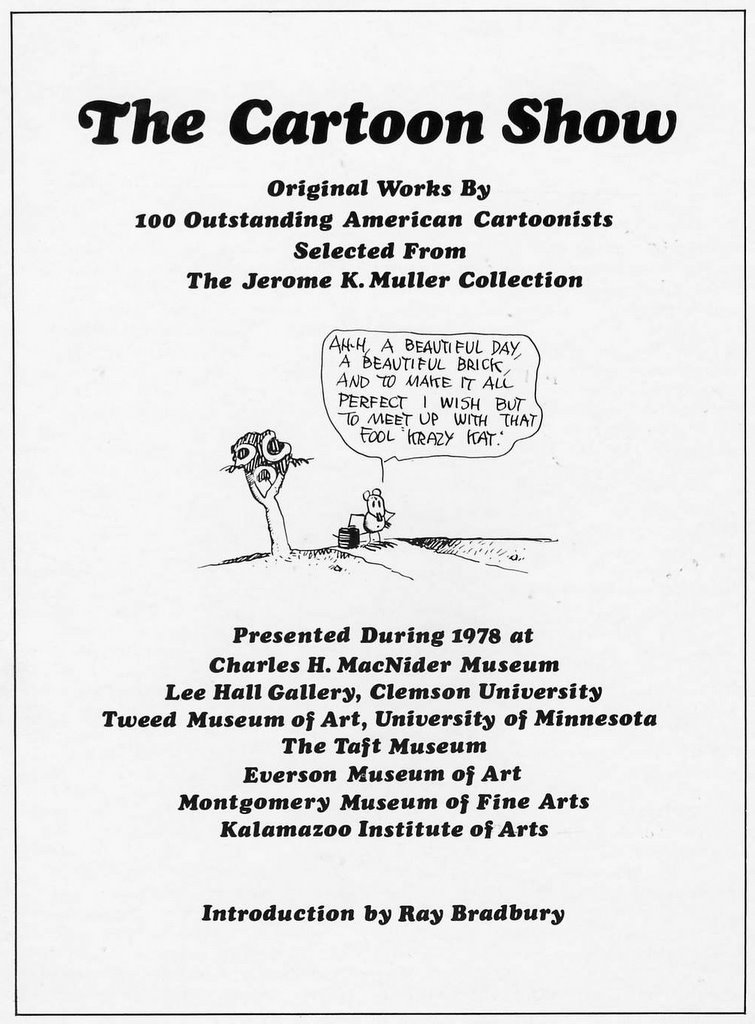
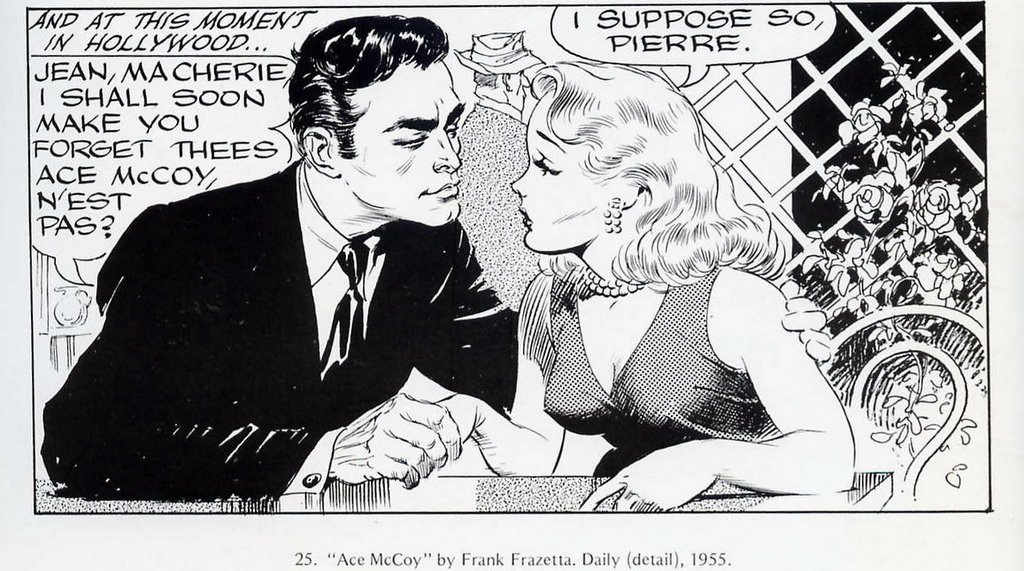
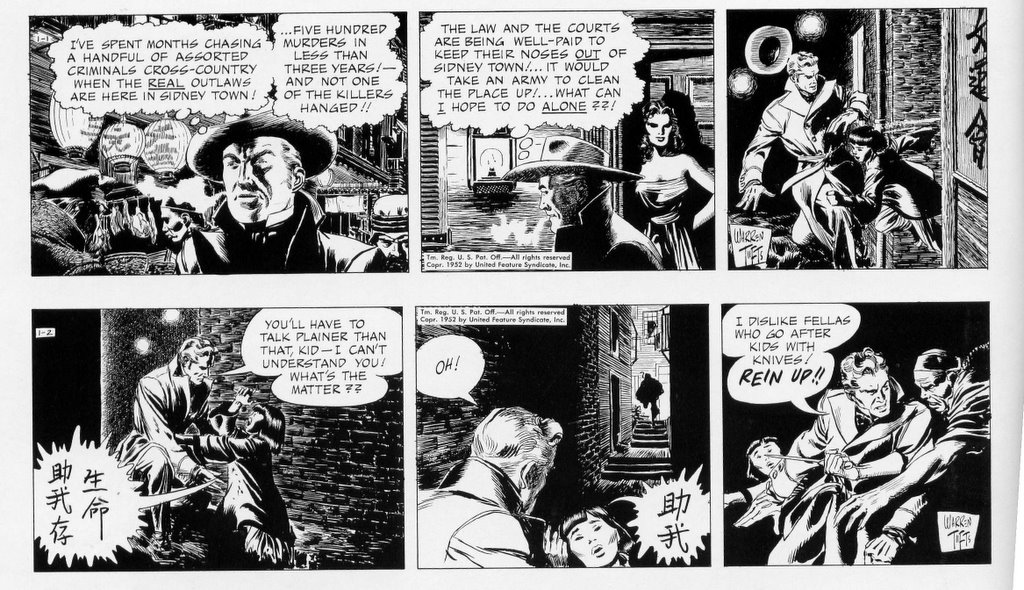
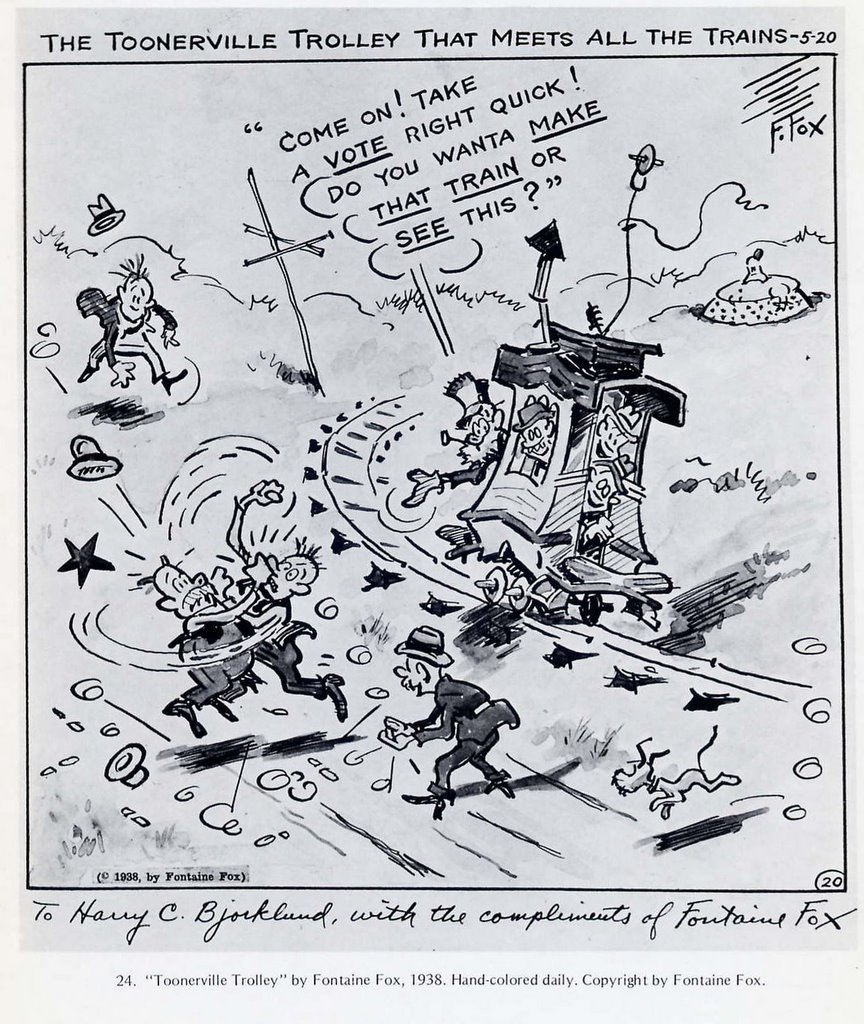
The Cartoon Show was, in fact, a travelling museum exhibition which I saw at the Taft Museum in Cincinnati in 1978. Touting "Original works by 100 outstanding American cartoonists" it attempted a cross-section of comic strips, comic books, magazine panel cartoons and animation art but still ended up concentrating mainly on the more universally popular newspaper strips. In fact the comic BOOK art consisted of the Kirby piece I posted yesterday, a Dan Adkins SUB-MARINER page, A Crumb page and illustrations by Joe Shuster, "Bob Kane" and John Romita, Sr. That's it. No Ditko, no Steranko, no Wolverton, no Wood, no Kurtzman, no...well, you get the idea. Still, you can quibble with what WASN'T represented but the pieces that were there were fascinating. The L'IL ABNER panel at left is the cover of the catalog they put out that featured a loving intro by Ray Bradbury. Also depicted here is a section of a Frank Frazetta strip that I stared at forever. Just amazing! A couple Warren Tufts strips and a signed TOONERVILLE TROLLEY panel are just a few of the delights of the catalog as well as the long over exhibition. I spent hours there looking at some of the first original art I ever really had the chance to see and it was hanging on museum walls! I TOLD my parents comics were art!

Friday, February 17, 2006

The Magic of Kirby


I don't think this necessarily occurs anymore but, back when I was a kid, there came a time when you were expected to give up comic books in favor of sports, junior high and...well, girls. It's just the way it was done. I guess my generation was one of the first to protest that particular ritual of life but that doesn't mean our parents didn't push it. With me, it started in late 1970 when I was 11 years old and at first I didn't fight it. I was ready to "grow up." Since Carmine had taken over at DC, I felt that their comics had suffered greatly in quality. Who in their right mind would put Mike Sekowsky in charge of a book and then let him--no! Encourage him!--to screw up anything and everything the fans liked about it? Thus we got a powerless WONDER WOMEN playing Mrs. Peel to her ancient Chinese secret, "I Ching," the "New, Hunted METAL MEN" with their rubber human masksand SUPERGIRL in a succcession of badly designed new costumes. UGH! Meanwhile, at Marvel things weren't much better since Jack Kirby had left and taken his staggering imagination with him. Steranko had drifted away, also and Ditko was already long-gone. Then I saw this DC ad. In those pre-fan press days, news didn't travel quite as fast. I knew Jack Kirby had relinquished the FF and I vaguely recalled reading of a California move but I had no idea he was about to turn up at DC until this ad. Even though I found myself purchasing less and less of the newly price-increased comics in those days, I made a point of grabbing Jack's JIMMY OLSEN and then THE FOREVER PEOPLE. I didn't read the latter, however, tossing it aside on the coffee table with various issues of NATIONAL GEOGRAPHIC and some S&H stamp booklets. Then one day I saw the edge sticking out and I read it finally, meeting Mark Moonrider, Beautiful Dreamer, Big Bear, Vyken (the Black) and Serifan for the first time. I was hooked again. There was something otherworldly about Kirby's prose, something exciting about his storytelling and, in spite of Vinnie Colletta's much-maligned rerputation, something comfortable and amazing about the King's art. I began seeking out all things Kirby and peripherally, other comics that now looked better than they had been looking before. My parents gave up on the notion that I would ever give up comics and I haven't. That's the true magic of Kirby!

Thursday, February 16, 2006

Mario and Luigi


George Clooney's mom gave me my first video game system in 1982. Actually, she gave me my second one also as the first one was defective. That's all a whole story in and of itself but that's not the one we're here to discuss today. The system was an Atari 2600 and it came with the game TANK. Before long, we had added SPACE INVADERS, PITFALL, KABOOM! and CHICKEN among others. I got particularly good at SPACE INVADERS. Later on, we bought a Sega system just as they were becoming obsolete. Never got too many games but I loved PENGUIN LAND. Then we got our first Nintendo and discovered the worlds of the Mario Brothers, Mario and Luigi! In case you've been vactioning on Jupiter for the last couple decades, these guys rule when it comes to video games. The premise is so ridiculous and yet seemingly so perfect for the digital world! Two Italian plumbers travel between and within worlds in giant green pipes, usually to save the Princess of the Mushroom Kingdom. There are friends, foes, monsters, traps and set pieces aplenty. Over the years, the pixalated art style has grown to a lush 3-D world and included Tennis, Baseball, Go-Karts and Soccer along with various adventure, mystery and arcade-style games. The heart of it all still remains the Mario brothers, two plucky little Italian (Well, technically Japanese!) guys who refuse to let any obstacles stop them from saving the day. My personal favorite video game of all time is PAPER MARIO. My son, as you may recall age 9, has spent much of his life learning his way around a console and Mario is always a favorite. They tried him in cartoons though (Capt. Lou Albano) and then in a live-action movie (Bob Hoskins) but Mario in his element remains THE true video game superstar! Although he first appeared, I believe, in the original DONKEY KONG, here's an early eighties ad for the first actual Mario Brothers game.